

A World Without Fear
Statement on Poverty
Manifestos
Policy Statement
Campaigns
» Counter-Terrorism Bill 2008
» Guantánamo Bay
» Dale Farm Travellers’ Site
» Rights of the Child
Archives
» Previous News
» Briefings
» Events
Links
Contact Us
Universal Declaration of
Human Rights
Send this page to a friend
|
Obama's failure to close Guantanamo is complete On 4 April 2011 the US Attorney General Eric Holder announced that the alleged 9/11 conspirators will face trial by military commissions at Guantanamo Bay; the complete failure by the Obama administration to fulfil its promise to close the notorious prison camp is now complete. Director of Cageprisoners and former Guantanamo Bay detainee, Moazzam Begg, said of the news, “Of the 779 men once held in Guantanamo as ‘the worst of the worst ‘only six them been successfully prosecuted there. These men included a cook, a driver, a video-maker and a child. This statistic in itself would render Guantanamo an object of ridicule – if the matter was not so deadly serious. Prosecuting these five men, the ‘9/11 conspirators, through the military commissions will appear to many as an attempt to legitimise the illegitimate. The fact is that some of these men were waterboarded and had their children abused in front of them. How does one avoid such information from challenging the whole process in open court? Trial by military commission." Cageprisoners believe that by reverting to much discredited military commissions the US government will completely undermine any legitimate prosecution case that they may have had against the men. Further, no trial under military commission will be considered to have provided due process and will result in the cases being used to exemplify how the US system of justice is inadequate. Holder refused to rule out the use of the death penalty in the case of the men who will face the military commission. Such a move would only be used as collateral by those who seek to highlight the hypocrisies in the US justice system. Read more at www.cageprisoners.com News from Guantánamo The journalist Andy Worthington has published another article on Guantánamo Bay, specifically concerning President Obama's recent decision to lift the ban on trials by Military Commission of the camp's detainees. Guantánamo Update There is a programme of viewings of Andy Worthington's latest film 'Outside the Law: Stories from Guantanamo', which is billed as the Save Shaker Aamer tour. Even though he was cleared for release from Guantánamo in 2007, Shaker, a Saudi national with a British wife and four British children, is still held there. This is in spite of the fact that he was included in the financial settlement that the British Government reached with former prisoners; despite the fact that the Metropolitan Police are investigating his claims that British agents witnessed his abuse by US soldiers in a prison in Afghanistan, before his transfer to Guantánamo in February 2002; and despite the fact that the coalition government's planned judicial inquiry into British complicity in torture abroad, announced by Prime Minister David Cameron last July, cannot legitimately start while he is still held. More information about the coalition government inquiry, the actions taken by NGOs to ensure it is not a whitewash, and Shaker Aamer's case, can be found in this article by Andy Worthington. Guantánamo Update This news from The Guardian's Richard Norton-Taylor and Ian Cobain on the British residents formerly detained at Guantanamo Bay: "British residents held at Guantánamo Bay could be offered millions of pounds in compensation for wrongful imprisonment and abuse after the court of appeal today dismissed an attempt by MI5 and MI6 to suppress evidence of alleged complicity in torture. The judges ruled that the unprecedented legal move by Britain's security and intelligence agencies – which the attorney general and senior Whitehall officials backed – to suppress evidence in a civil trial undermined the principles of common law and open justice." Guantánamo Shaker Aamer: Time is Running out... Report - Shaker Aamer: the Last Londoner in Guantanamo Bay – meeting at Battersea Arts Centre 11 July 2009. Click here to read the report. There is also a model letter which you can send to David Miliband, the Foreign Secretary, in support of the current Guantanamo inmates. Torture, Secrecy and the British State Gareth Peirce is a leading lawyer who has represented the Birmingham Six, the Guildford Four and the family of Jean Charles de Menezes. She also represents a number of individuals who have been the subject of rendition and torture in the past, others still held today in Guantánamo Bay, in prisons in the UK on the basis of secret evidence, and in secret prisons abroad under regimes that continue to practise torture. ‘Make sure you say that you were treated properly’ Gareth Peirce writes about Torture, Secrecy and the British State Was it like this for the Irish? Gareth Peirce on the position of Muslims in Britain “The history of thirty years of conflict in Northern Ireland, as it is being written today, might give the impression of a steady progression towards an inevitable and just conclusion. The new suspect community in this country, Muslims, want to know whether their experience today can be compared with that of the Irish in the last third of the 20th century.” To read this article which was published in the London Review of Books on 10 April 2009, click here. Binyam Mohamed New evidence in Binyam Mohamed 'torture' case Documents reveal MI5 official visited Morocco three times during period ex-Guantánamo detainee claims he was interrogated. Click here to read the full article by Richard Norton Taylor Press Release by Leigh Day & Co Solicitors: COURT OF APPEAL OVERTURNS GOVERNMENT’S ATTEMPT TO DEFEND GUANTANAMO TORTURE CLAIMS WITH SECRET EVIDENCE : The Court of Appeal has today “firmly and unambiguously” rejected the government’s argument that it is open to a Court, in the absence of statutory power, to order a “closed material procedure” in relation to the trial of an ordinary civil claim, such as the claims of former Guantanamo detainees brought against the British Security Services and various government departments for alleged complicity in their torture and maltreatment over several years. On 18 November 2009, in a highly controversial judgment, Mr Justice Silber ruled that in principle it was possible for a Court to allow a party to rely on closed evidence and closed pleadings in a civil claim for damages. As the law currently stands, if the government successfully claims “public interest immunity,” excusing them from disclosing material in the civil courts (for instance, on the grounds of national security) they are then not allowed to rely on the material. The government’s proposals would have meant that they would be able to rely on such evidence, the judge trying the case would be able to see it and make a judgment dependant on such evidence but the other party and their legal team would not be able to see it, respond to it or cross-examine witnesses on it . This was particularly troubling in the context of such serious allegations, leading the Claimants to appeal against the judgment. Today, Lord Neuberger (Master of the Rolls), Lord Justice Maurice Kay and Lord Justice Sullivan unanimously agreed with the Claimants that such a procedure would undermine some of the most fundamental principles of the common law and fly in the face of the Civil Procedure Rules. Their Lordships referred to the “cardinal requirement that the trial process must be fair, and must be seen to be fair… which under the common law means that a trial is conducted on the basis that each party and his lawyer, sees and hears all the evidence and all the argument seen and heard by the Court.” They also referred to another fundamental principle of English law that a party to litigation should know the reasons why he won or lost. Their Lordships commented that “[i]f the court was to conclude after a hearing, much of which had been in closed session, attended by the defendants, but not the claimants or the public, that for reasons, some of which were to be found in a closed judgment that was available to the defendants, but not the claimants or the public, that the claims should be dismissed, there is a substantial risk that the defendants would not be vindicated and that justice would not be seen to have been done. The outcome would be likely to be a pyrrhic victory for the defendants, whose reputation would be damaged by such a process, but the damage to the reputation of the court would in all probability be even greater.” Speaking after the judgment was delivered today, Sapna Malik, Partner at Leigh Day & Co, acting for Binyam Mohamed said: “We are delighted that the Court of Appeal has fully accepted the Claimants’ arguments that the government has been seeking to introduce, via the backdoor, unconstitutional and manifestly unfair measures to defend these most serious of allegations, which the Courts must be emphatically resist.” Clive Stafford Smith, Director of Reprieve, who acted for Binyam Mohamed in the United States, said: “Perhaps the most dangerous legacy of the ‘War on Terror’ is a creeping secrecy that threatens to shutter the workings of British justice away with access limited to a privileged few. We applaud the Court of Appeal’s excellent decision to keep our courts open, so that the British public may continue to see justice done in their name. It is crucial that our government accept this ruling, and stop hiding the mistakes of the ‘War on Terror’ years. We cannot learn from history unless we know what it is.” The Tragedy of Guantánamo On 10 June 2006 it was announced that three detainees at Guantánamo Bay , two Saudi Arabians and one Yemeni, had taken their own lives. The US Deputy Assistant Secretary of State for Public Diplomacy issued a brutal response. She said that the deaths were the strategy of Islamic extremism and that they were a good PR move by people who showed no respect for people's lives. US Navy Rear Admiral Harry Harris said the suicides were ‘not an act of desperation' but ‘an act of asymmetric warfare'. FURTHER INFORMATION ABOUT GUANTANAMO BAY |
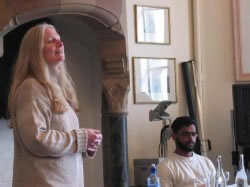 It is, of course, the US government which has shown no respect for people's lives. Official figures list 25 failed suicide attempts at Guantánamo to date, but defence lawyers estimate the figure is higher. Former detainee Moazzam Begg, answering questions at Social Forum Cymru in Aberystwyth on 30 April 2006, described how, suffering mental and physical torture, he himself had experienced a breakdown. This was not, however, the point that he had wished to underline in the talk he gave (following the publication of his book Enemy Combatant, Simon & Schuster). Indeed, he spoke very little of his own suffering, emphasising instead the need for justice for the detainees still held. He said that they should be given political asylum or refugee status, or brought to trial. As his father Azmat Begg had said whilst speaking at Aberystwyth two years previously, when campaigning so hard for the release of his son: it is not mercy that is being asked for, but justice.
 Become a Member of Peace & Progress
The membership fee is £36 / £12 concessions
©
Peace & Progress 2009
Website developed
by Wordsmith
